


Equal Opportunity

Again, it's time to rotate back into the broad market. Really, Deck, so soon?
Hear me out. Last month, as the negative seasonal period loomed, I began to get nervous about a bond market selloff. Now that it has arrived, I think it's time to reassess the market. What has changed? What threats remain? Is the bull market ending or just pausing?
The key indicators of market health are deeply oversold. Unless there is a profit collapse, the market has sufficient fuel to continue rising, albeit at a reduced pace. Estimates of third-quarter YOY earnings growth hover around 25%. Valuations have compressed to the high teens on a forward basis. And despite the existential threats posed to humanity by rogue agents, AI productivity gains are starting to show up in corporate bottom lines. Guardrails are now being developed, which should soothe investor sentiment.
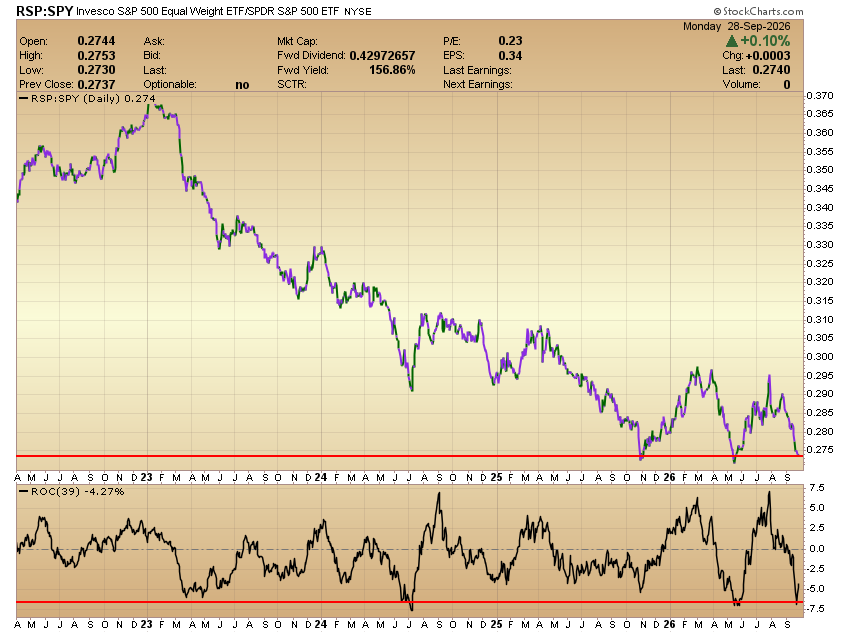
The broad market has suffered disproportionately as the rally in megacap tech has completely masked the correction. As shown below, the ratio of equal-weighted market to the tech-skewed S&P 500 has dropped back to a level that has held firm in the past. The bottom panel shows the 39-day rate of change of this ratio. For the third time in the past couple of years, it has a similarly oversold look and is actually starting to bounce.
Equal Weighted vs Index, S&P 500
As rate hikes go, the recent yield back-up is child's play compared to the experience in 2022. That year, the abrupt end of COVID-19-driven financial manipulation wiped out 40% of investors' fixed-income wealth in less than 9 months (chart below). The modest 15% drop has been absorbed without any disruption to credit markets because the largest issuers of debt have been the U.S. Treasury and the Hyperscalers - both strong credits (for now). The normalization of long-duration fixed-income assets is now critical for the market. If bonds stabilize in the near term, stocks will be the best place to be, as long as the Fed remains behind the curve.
U.S. 10 Treasury Bond Yield; TLT Performance

What remains of the bearish case revolves around two 'known unknowns'. Will the War with Iran that has choked supply chains end anytime soon? And will a political upheaval ensue from the Nov. 3 election?
Trump holds the keys to the kingdom on those issues. I'm still in the hope-as-a-strategy camp for now, but clairvoyance is not part of my skill set.
So place your bets as you see fit. We have dodged the AI hack and bond market bullets for now. For those of you who can remember my "tanks-at-the-border" call during the 1991 Desert Storm, the current setup is similar. This time it's more like "oil tankers at the choke point", as any recovery in energy supplies would translate into renewed confidence in the broader economy.
Look for U.S. banks to rally sharply if there is a resolution to the war. Torstein Slok's "run on the banks" call yesterday, while theoretically possible, seems premature and has generated an attractive entry point for the likes of RY, BAC, and JPM. Low-end retailers like QSR, MCD, and WMT are likely to benefit from any drop in gasoline prices. Small Caps, Airlines, and Retail stocks should rally hard as well.
The markets need to see the end of this ill-conceived war for the equal-weighted rally to ignite. Let's hope the third time's a charm.
Risk Model: 3/5 -Risk On
Soaring global bond yields have had little effect on stock prices, despite all attempts at talking the market into a correction. Sentiment and short -term price momentum - (RSI) - are negative, but Implied Volatilty, CU/AU, and 200 DMA indicators remain constructive. The latter is slowly correcting as the broader market deteriorates beneath the surface.
Utility stocks are deeply negative, but they have dug in their heels recently, and money has stopped flowing out (CMF). This key indicator must recover to stabilize the broad market.
Dow Utility Average

Bond market implied volatility has jumped recently but remains well contained. With the Fed taking off the interest-rate training wheels, future moves can be expected to be more extreme, leading to higher-for-longer IV levels.
Bond Market Volatility Index

Comments